
The genesis of this column was a desire to alleviate my daughter’s legitimate angst regarding her annual recognition of Black History Month, which she found heavy with legacy.
Yes, I said. You’re absolutely right, I told her. It’s not a pretty story, and we don’t just tell it every year, it’s written in our eyes and our hands and our skin.
But that is not our only story. We have marvels and miracles, hilarity and harmony, and so much joy within our perseverance. We are a mathematical impossibility, from property to President in under a sesquicentennial. We hold the nation’s dreams in our ability to hold high notes and throw a perfect spiral; we steer the public good by standing up and staring down. As we endure, we invent; as we’ve suffered, we’ve uplifted; as we have buried - we have planted.
“Yeah, I’m 10.” she said. “That all sound’s nice, but it’s a really sad story.”
Thus the very first :lowerblackpain column
https://lowerblackpain.substack.com/p/672-hours-of-fun
explains my initial predicament; how best to pass along the significance of Black History Month without making the experience overwhelming for a middle-schooler. And an old guy.
I ended up telling her that everything she does is Black History by definition, as she is an African-American (Black) and it’s in the past (History). In fact, my own stories and those of my mother and grandparents (and even their parents) might provide meaningful context to the flood of historical data.
“What if I tell you more about stuff that’s happened to me?”
She didn’t exactly roll her eyes… more of a respectful averting.
“I already know everything that’s happened to you, you’ve told me like a million times.”
“Not…everything. I have some more fun stories to tell you.”
“That aren’t about being old?”
“Well, no. A lot of them are about being young. Like, your age.”
“But my age in the old days.”
She had me. “Yeah. But some are funny.”
“Like what?”
Unprepared for a command performance of light entertainment clarifying the entirety of Black achievement through personal anecdote, I kind of froze.
These columns are the result; a family grimoire of tales both cautionary and only marginally consequential. Yet halfway though this column’s fourth year, I do realize that I may have strayed a bit from the original directive. I asked my (now 14 year old) daughter for guidance.
“Is there anything about Black History that you’d like to…y’know, ask me?”
“I already get 100% in Black History. It’s the same every year.”
“Martin Luther King?”
“Yep. ‘He was awesome, then he died.’ Pre-school, grade school, and middle school. I always know way more than the teachers do.”
I was proud about that last fact, but then again, the bar seemed pretty low.
“Is there any story that stands out to you?”
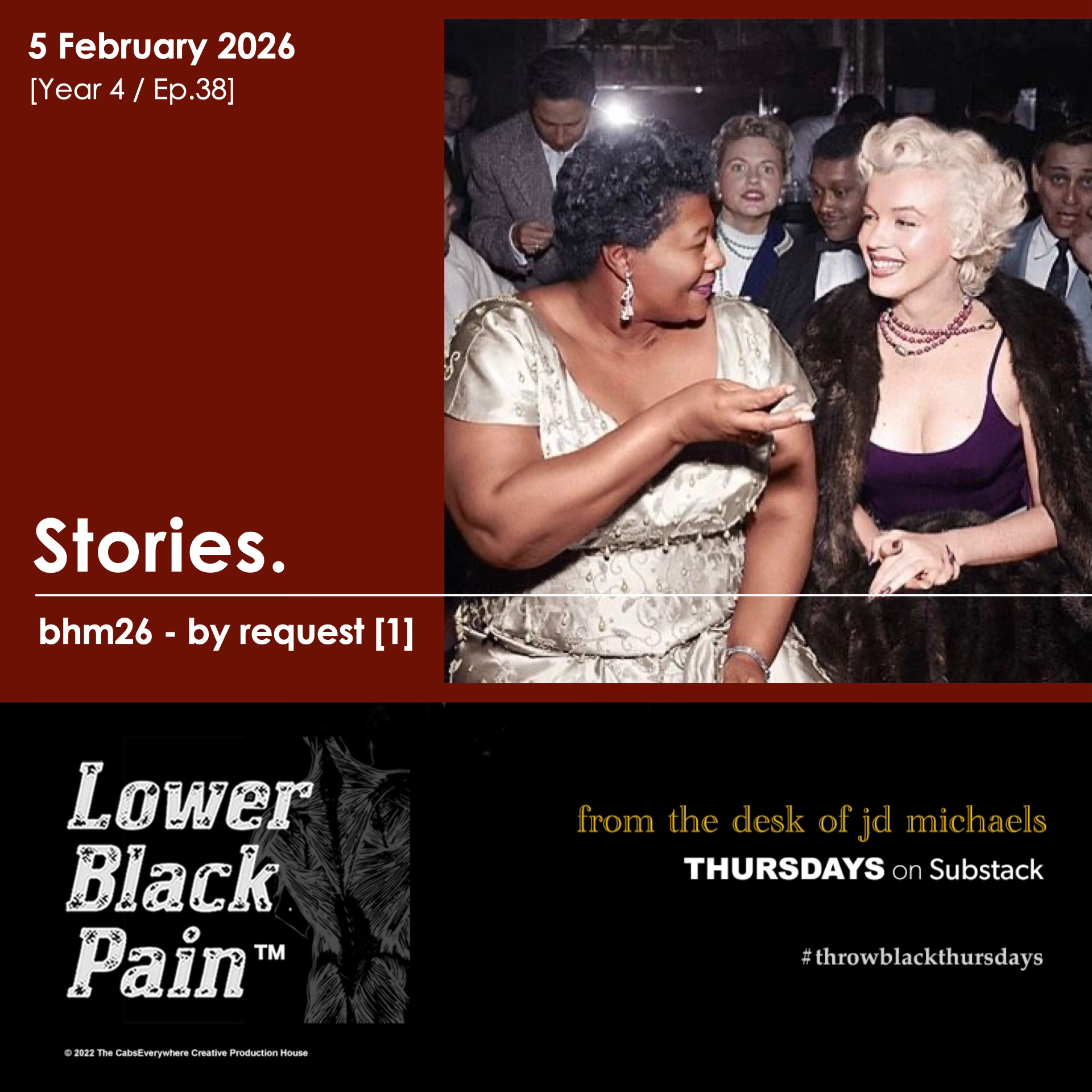
She thought about it. “That picture that’s always on your desk, of Ella Fitzgerald and Marilyn Monroe. That’s a nice story.”
There is a picture that is always on my desk, of Ella Fitzgerald and Marilyn Monroe.
The story goes that in the spring of 1955, The Mocambo - a popular Los Angeles jazz club - did not want to book Ella Fitzgerald because the club owner said she lacked “glamour”. Marilyn Monroe loved Ella, and contacted the club owner, and told him that if he booked Ella she would sit in the front row every night and bring other celebrities.
All that is true. And that is where most versions of this story end, leaving one to believe that the photo is of the two women in the front row of the Mocambo during that historic run.
While the picture does capture the two women sitting at a jazz club, a little research reveals that it is not during Ella’s run the Mocambo.
The two were friends - that is true. And Marilyn did, in fact, secure that job for Ella, and got Frank Sinatra and Judy Garland there on opening night. But Marilyn was in New York City working on “The Seven Year Itch” at the time and was not able to attend any of the shows, which didn’t prove necessary, as the run sold out due to Ella Fitzgerald… y’know, being Ella Fitzgerald.
The thousand words this picture tells are poetry rather than journalism.
But in that turbulent age when empathy and alliance with those less privileged could cost careers or much, much more, the most famous woman in the world at the time used her power to help her friend.
Which is a nice story, particularly for all those times when I forget how powerful kindness is as a weapon against ignorance and greed - a sword nigh indefensible as long as there is a hand brave enough to wield it.